Knowledge Base
CM Punjab Bike Scheme — every question, answered
40+ questions applicants actually ask, organized by topic: who qualifies, how balloting works, what the Bank of Punjab checks, Debt Burden Ratio rules, co-borrower requirements, insurance and ownership transfer.
اہم سوالات کا خلاصہ — اردو میں
کیا درخواست کی کوئی فیس ہے؟ نہیں — درخواست صرف bikes.punjab.gov.pk پر مفت جمع ہوتی ہے۔ کیا خواتین کو لائسنس چاہیے؟ جی ہاں، لرنر پرمٹ سب کے لیے لازمی ہے۔ کیا دونوں بہن بھائی درخواست دے سکتے ہیں؟ دے سکتے ہیں، مگر بائیک ایک خاندان میں صرف ایک ملے گی۔
قرضے کی منظوری کے لیے ضامن (والد، والدہ، شوہر یا بہن بھائی) کی آمدنی کی تصدیق ہوتی ہے اور قرض کا بوجھ آمدنی کے 40 فیصد سے زیادہ نہیں ہونا چاہیے۔ بائیک تمام اقساط مکمل ہونے تک بینک کے نام رہتی ہے اور اس کے بعد این او سی جاری ہوتا ہے۔ رہنمائی کے لیے ہیلپ لائن 042-111-333-267 پر کال کریں۔
Section 1
Eligibility and applying
Who is eligible to apply for the scheme?
Students currently enrolled as regular (on-campus) students in degree programs at any public or private university or graduate college in Punjab that is recognized by the HEC. Your bonafide status as a regular student is verified directly with your institution — if the institution cannot confirm it, the application fails. Phase 2 also opens categories for government school teachers (via PTF) and government employees in BPS 1–16.
Can a student apply any other way than through the web portal?
No. The online portal at bikes.punjab.gov.pk is the only application channel. There are no paper forms, no bank-branch submissions and no agents. Any person or website offering to submit an application for you outside the portal is misleading you.
Is the scheme valid for students who don't attend university on a regular/daily basis?
No. Only regular, on-campus students qualify. Distance-learning, online, evening and correspondence programs — including Virtual University and Allama Iqbal Open University — do not meet the requirement, because enrollment must be verifiable as regular attendance.
I don't have a driving licence. Am I still eligible?
Not without at least a learner's permit. A valid motorcycle driving licence or learner's driving permit is mandatory for every applicant and is validated before balloting. A permit is quick and inexpensive to obtain from your local licensing authority, so arrange it before you apply.
Is a driving licence or learner's permit required for female students as well?
Yes. The requirement applies equally to male and female applicants, with no exceptions. Female applicants choosing scooties or e-bikes still need at least a learner's permit.
I am a female student — can I apply for a petrol bike?
Yes. Female students can choose petrol bikes and have a substantial reserved quota (7,324 of the 19,000 petrol bikes in Phase 1). The choice between petrol and electric is yours — see our electric vs petrol comparison to decide which suits your commute.
Can my sibling also apply under this scheme?
Both siblings may apply and both may even be selected in balloting, but only one bike is issued per family. The restriction is enforced through CNIC family records during the Bank of Punjab's post-ballot scrutiny.
Can I apply for two bikes?
No. You must pick one lane: either an electric bike or a petrol bike, never both at the same time. One application, one bike per applicant — and ultimately one bike per family. Submitting duplicate applications risks disqualification of both.
How is the quota allocated between male and female students, and Punjab vs out-of-province students?
Phase 1 allocated 19,000 petrol bikes — 11,676 for male and 7,324 for female students — distributed district-wise among Punjab-domiciled applicants according to Population Census 2023 figures. The electric bike allocation opened at 1,000 units (700 male / 300 female) and was subsequently expanded, with the growth overwhelmingly reserved for female students. E-bikes are limited to campuses in Lahore, Rawalpindi, Faisalabad, Multan and Bahawalpur; out-of-province students qualify for e-bikes only, and only if studying in one of those five cities.
Section 2
Bikes, prices and installments
What types of bikes are offered under the scheme?
Two types: conventional petrol motorcycles (typically 70cc models such as Honda CD-70 and similar approved brands) and electric bikes/scooties from the approved catalogue on the portal. Petrol bikes carry financing up to PKR 150,000; electric bikes up to PKR 250,000.
Can I purchase a bike of any price under the scheme?
No. You can only select models listed in the official portal catalogue, within the financing caps — PKR 150,000 for petrol and PKR 250,000 for electric. Bikes outside the catalogue are not eligible regardless of brand or price.
After submitting my application, can I change my choice of bike?
Yes, but only until the deadline announced for that phase (in Phase 1 the cut-off was 29 April 2024). After the deadline the selection locks, because quotas and financing are calculated against your recorded choice — so decide carefully before you submit.
What if I choose a bike that costs more than the financing limit?
Financing is capped at PKR 250,000 for electric and PKR 150,000 for petrol bikes. If your chosen catalogue model exceeds the cap, you pay the entire difference upfront to the Bank of Punjab after being declared successful — the government does not cover any amount above the ceiling.
Can I customize my installment plan?
No. The installment structure is standardized under each plan — the amount and tenure are fixed in the financing agreement. What you can do is settle early: early repayment is allowed without penalty in consultation with the Bank of Punjab.
Does the government contribute any money under the scheme?
Yes, substantially. State Bank rules require the borrower to put up 30% equity — PKR 45,000 on a PKR 150,000 petrol bike. The Punjab Government pays PKR 20,000 of that on your behalf, and it also pays 100% of the bank markup, making the loan genuinely interest-free. Phase 1's total subsidy came to roughly PKR 1 billion; the Phase 2 allocation is PKR 2.6 billion.
Is the registration cost of the bike included in the price?
No. Vehicle registration is separate and paid by the applicant after delivery. Budget for it on top of the down payment — the exact amount depends on the vehicle type and the Excise & Taxation fee schedule.
What is important to note about paying monthly installments?
Installments are deposited monthly into the dedicated account opened with the Bank of Punjab for the scheme, by the borrower or co-borrower. Late payment charges apply the moment a deposit is delayed, and chronic default can end in repossession since the bike stays in the bank's name until the last payment. Set a standing reminder a few days before each due date.
Section 3
E-balloting and selection
How does the balloting take place?
When applications exceed the allocated quota — which they always do — the Punjab Information Technology Board (PITB) conducts a computerized random ballot. The draw runs electronically inside the pre-set quotas for gender and districts, so no individual can influence the result. Results are announced by SMS, email and on the portal.
If I submit my online application, will my name be included in the e-balloting?
Only after pre-balloting verification passes. Before the draw, your regular-student status is confirmed with your institution and your driving licence or learner's permit is validated. Applications that fail these checks never enter the ballot.
What is meant by post-balloting scrutiny?
Winning the ballot is provisional. The Bank of Punjab then examines the financial side: your co-borrower's income and ECIB credit report, the Debt Burden Ratio, physical verification where needed, and the authenticity of every document. Failing any of these checks means the bike is not issued despite the winning ballot.
Is there any grievance redressal mechanism?
Yes. Complaints can be lodged online directly through the web portal's grievance facility, and queries also go through the BOP helpline (042-111-333-267) or [email protected]. Keep your application ID handy — every follow-up needs it. Note that eligibility-based rejections are final and not appealable.
Is there a helpline available for guidance?
Yes — the Bank of Punjab helpline at 042-111-333-267 handles scheme questions, and [email protected] answers portal issues by email. Both are free; no legitimate channel ever asks for payment.
Section 4
BOP loan, DBR and co-borrower rules
Can BOP reject or decline a student's loan application?
Yes, on five grounds: a failed physical verification of the co-borrower, a bad credit history on the co-borrower's ECIB report, a Debt Burden Ratio above the 40% ceiling, failure to clear name-screening and other regulatory checks, or fake/false/incorrect information submitted to the bank. That last one is the most dangerous — a fabricated document doesn't just fail the application, it can carry legal consequences.
What is Debt Burden Ratio (DBR) / repayment capacity?
DBR measures how much of a person's monthly income is already committed to debt repayments. It answers one question for the bank: after existing obligations, can this household comfortably absorb the new bike installment? A lower DBR means stronger repayment capacity.
How is the Debt Burden Ratio calculated?
All monthly debt obligations — existing loan installments plus the proposed bike installment — are divided by net monthly income, expressed as a percentage. Example: income PKR 50,000, existing installments PKR 8,000, bike installment PKR 3,000 → DBR = 11,000 ÷ 50,000 = 22%.
What is the DBR requirement for the bikes scheme?
The Debt Burden Ratio must not exceed 40%. If the co-borrower's combined obligations including the new installment cross 40% of net monthly income, the financing is declined.
Why is a co-borrower/guarantor required under this scheme?
Because most students have no independent income, the bank needs a financially capable adult who shares legal responsibility for repayment. The co-borrower's verified income is what the loan is actually assessed against. Students who have their own verifiable income source may not need one.
Who can be the co-borrower/guarantor?
A parent, spouse or sibling of the applicant with a verifiable income. Structurally, the loan is booked in joint names: the guarantor signs as Primary Borrower and the student as Secondary Borrower, and it is the guarantor's income that feeds the Debt Burden Ratio calculation. If the student has their own income source, the student becomes the Primary Borrower and no guarantor is needed. One firm exclusion: an overseas resident cannot serve as co-borrower, guarantor or primary borrower.
What details of the co-borrower are required in the loan application?
Three blocks of information: personal details (CNIC, relationship, contact), income details with supporting proof, and a complete record of every loan they have previously taken — its current status and monthly installment. That loan history is what the bank uses to compute the Debt Burden Ratio, so gather it accurately before you start the form.
What is meant by 'source of income'?
Any regular, demonstrable inflow the co-borrower (or an earning student) lives on: salary, business earnings, agricultural income, rental income, or professional earnings of the self-employed such as doctors and lawyers. The bank cares that it is regular and provable, not what type it is.
What is formal vs informal income?
Formal income can be verified through standard documents — a bank account statement, tax return, audited financials or a registered rent agreement. Income that cannot be evidenced through those channels — cash earnings from a shop, trade work or an unbanked salary — counts as informal. Both can qualify, but informal income needs extra verification.
What does BOP require to verify an informal source of income?
Indirect evidence the bank calls proxies: recent electricity bills, paid school-fee challans for the earner's children, sale and purchase receipts for a shop or self-run business, or a signed and stamped letter from an employer confirming a cash salary on company letterhead. The bank evaluates these together to estimate real income — so the more of this paper trail you assemble in advance, the smoother the assessment.
How will a student know whether BOP approved or rejected the loan?
The bank broadcasts an SMS to your registered mobile number stating whether the application is approved or rejected. Approved applicants additionally receive a phone call from BOP walking them through the post-approval formalities — another reason to keep your registered SIM active and answer unfamiliar landline numbers during this window.
Section 5
Delivery, insurance and ownership
What are the post-approval requirements before the loan is disbursed?
Four steps in sequence: sign the Facility Offer Letter, open a dedicated account with the Bank of Punjab for the scheme, deposit your down payment into that account, and sign the legal and charge documents that secure the financing. Only after all four does disbursement to the dealer proceed.
How is the bike delivered to a successful applicant?
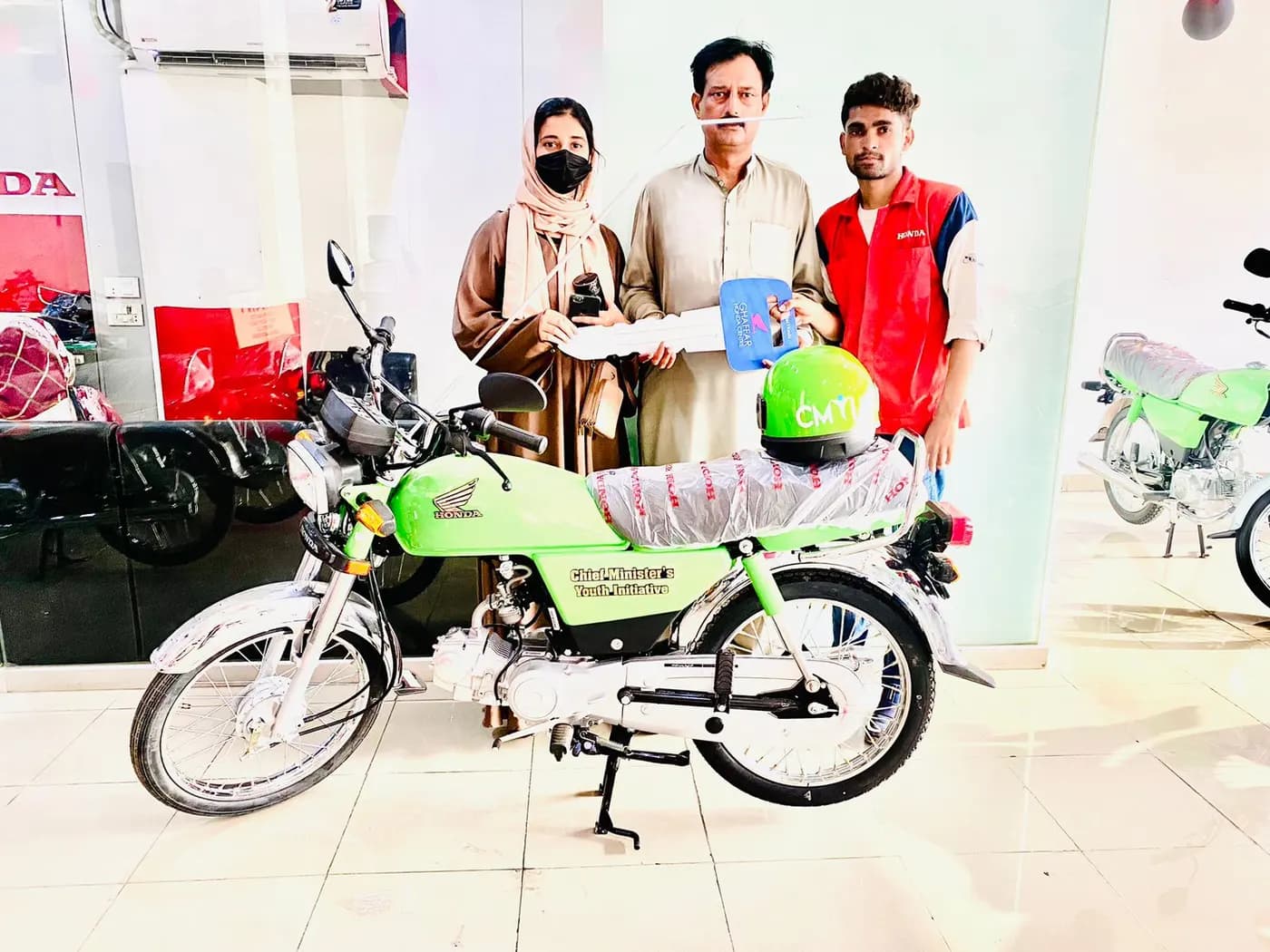
Once the dealer receives payment, they book your bike (or confirm stock) and report its chassis and engine numbers to the bank so insurance can be activated. BOP then issues a Delivery Order in the dealership's name and hands it to you — you present it at the dealership, verify the chassis/engine numbers against the paperwork, and ride out with documents and helmet. These are exactly the moments in our delivery gallery.
Who arranges the insurance of the bike?
The Bank of Punjab arranges coverage through insurance companies on its approved panel, and the bike is insured before handover. The premium is borne by the applicant, structured painlessly: the first year's premium sits inside the down payment, and the second year's is spread across the first year's monthly installments — no separate insurance bill ever arrives.
When does BOP issue the No Objection Certificate (NOC) to transfer the bike?
Upon full and final adjustment of the bike loan — every installment paid and the account settled to zero. The NOC releases the bank's lien so the bike can be transferred into your name; until then it cannot be sold, transferred or mortgaged. Early settlement brings the NOC forward with no penalty.
Can I sell the bike during the installment period?
No. The bike remains hypothecated to the Bank of Punjab until every installment is paid and the NOC is issued. Selling or transferring it earlier breaches the agreement and can trigger recovery action.
Section 6
General scheme questions
What is the last date to apply in 2026?
The Phase 2 student window closed on 10 June 2025, while the teacher portal at ptf.punjab.gov.pk opened in April 2026 and accepts applications. The next student window hadn't been announced as of mid-2026 — new dates are always published first on bikes.punjab.gov.pk.
Is the scheme only for Lahore and big cities?
Not anymore. Phase 1 covered five cities (Lahore, Faisalabad, Multan, Rawalpindi, Bahawalpur). Phase 2 expands to all 36 districts of Punjab, with petrol-bike quotas distributed by district population. The teacher scheme has no city restriction at all.
What is the difference between PM PAVE and the CM Punjab scheme?
They are entirely separate programs. PM PAVE is federal (pave.gov.pk): all of Pakistan, up to PKR 80,000 subsidy per bike, PKR 9 billion budget covering bikes, rickshaws and loaders. CM Punjab is provincial (bikes.punjab.gov.pk): Punjab only, PKR 2.6 billion budget, focused on students, teachers and government employees. If you qualify for both, you may apply to both.
Does applying cost anything?
No. Registration, verification and balloting are all free. There are no processing charges, agent fees or 'file fees'. Anyone asking for money in exchange for an application or selection is defrauding you.
Can government employees apply?
Yes — two tracks exist. The CM Punjab scheme includes a category for BPS 1–16 provincial employees, and on 23 April 2026 the Prime Minister approved interest-free e-bikes for federal employees up to BPS-16 under PAVE. Both are zero-interest; the employee portals and dates are announced on the official channels.
Can contract teachers apply for the PTF scheme?
Yes. Both permanent and contract teachers employed under the School Education Department of Punjab are eligible, provided they are actively serving, registered on PTF, aged 55 or under, and hold a licence or learner's permit.
Still stuck on a specific rule?
The deep-dive guides cover each topic with tables and examples: eligibility criteria, the application walkthrough, installment plans and prices, how balloting works and application tracking.
Didn't find your answer?
Reach the official channels — BOP helpline 042-111-333-267 or [email protected] — or send us a correction and we'll update the guide.